
 Call
Call
Rust is the oxidation of iron or iron-based alloys – such as steel - from exposure to oxygen and moisture. It is a form of corrosion that develops slowly but accelerates over time, so it's primarily seen in cars over a decade old.
Modern cars have rust-proof factory coatings, water-repelling oils, and paints that prevent rust but don't always completely seal everything.
The Good News
Every steel component on a car is prone to rust, but whether it's a problem depends on how old your car is and how long you're keeping it.
Even the worst arch rust and the like is repairable with car body paint repairs, and steel components like exhausts and cats are replaceable parts, so it's not like a touch of rust will have you looking around for a scrap yard.
For an older vehicle you don't intend to keep long-term, minor rust on replaceable steel parts like exhaust systems is expected and may not be worth the cost and effort to repair/replace those components if they still have some service life left.
The bigger worry is rust affecting structural components like the frame rails or unibody sections. But even then, if the rust is superficial when you sell or trade in the older car, it may not significantly impact the vehicle's value at that point.
The Bad News
Even stainless steel rusts when exposed—it just takes decades—so there is no escaping rust from affecting your car over a long enough timeframe.
Surface rust eventually extends through steel beyond a few microns to become penetrating rust that can destroy components.
There's no stopping penetrating rust from eating through the lot other than cutting out the section and welding in some fresh metal.
The bottom line is that car rust is delayable but not permanently haltable because metals have a finite lifespan once the oxidation process takes hold.
What Causes Rust on a Car?
The Recipe
To make rust, you need an iron-based alloy, water, oxygen, and time; it just so happens that you have all these things.
Throwing salt into the mix – you have plenty of this too with road salt – and that timeframe for rust shortens significantly.
Uncoated steels naturally form a thin, passive oxide coating that protects the underlying surface from corrosion, but salt can chemically disrupt this passive film, leaving the bare metal exposed and vulnerable to rusting.
The Metals
Uncoated steels and non-stainless types, including mild, carbon, and galvanised steel rust, with mild and carbon steels having zero resistance to oxidation.
Mild and carbon steel can show the first signs of corrosion within weeks, although they are rarely used in exposed car components.
Stainless steels are much more resistant to oxidation, sometimes taking decades to show their first glimpses of rusty-orange speckles – which is why today's car makers use stainless steel for most car parts like exhausts.
Age
Powder and rubberised factory coatings on steel components aren't invulnerable, and most get brittle over time.
Scratches, dents, and crush damage can break the seal with hairline cracks that allow water to get in behind and react with the metal.
Road salt can also stick to oils and lubricants and get behind coatings, accelerating the oxidation process and causing more rust.
Mileage
A higher mileage means more time exposed to all the nasty stuff on the roads. Mileage offsets age, too, so a younger car with a high mileage might have similar rust problems to an older car with low mileage.
Location and Climate
Remember that annoying road salt? Sea salt is no good for your car either, so cars parked by the sea are more prone to rust and other types of corrosion.
Higher relative humidity also accelerates rust by providing more moisture in the air that can condense on metal surfaces and drive corrosion reactions.
Types of Rust
Surface Rust
Surface rust is the accumulation of iron oxide on the top layer of paint or exposed metal.
Typically found in nicks, chips, and broken protective coatings, surface rust signals the beginnings of oxidation.
Prompt treatment at this stage offers the best chance of halting the spread before it gains a foothold. A rust inhibitor and coating is usually the best solution.
Scale Rust
Scale rust is rust that has eaten through the metal's outer skin.
Road salt and lubricants are red-hot catalysts for scale rust because the salt sticks to the lubricant and won't run off with water.
At this stage, the metal's defences are broken, and the oxidative onslaught is fully underway, but it doesn't necessarily spell the end for the metal.
Penetrating Rust
This represents the terminal, inoperable phase of rusting - the point of no return.
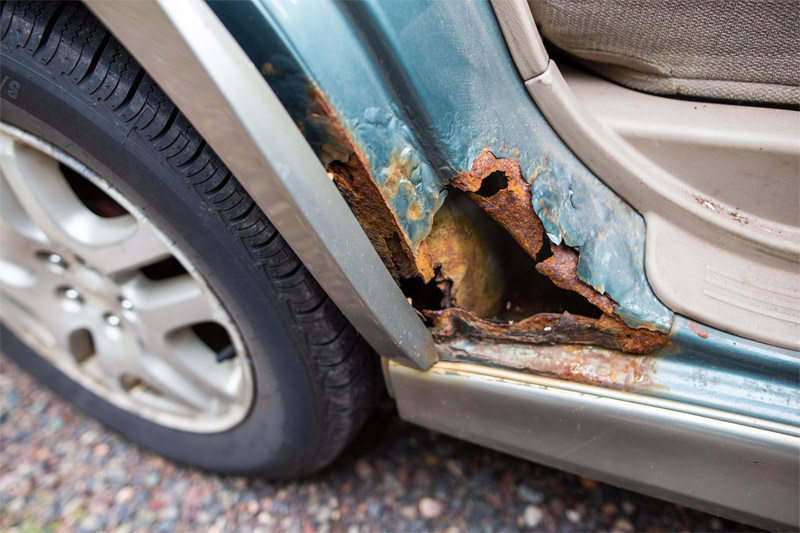
Penetrating rust eats away at the metal from the inside out, as oxidation has thoroughly violated it. Once at this stage, there is no recourse but to replace components, or cut away compromised sections and rebuild them with fresh material.
Common Car Components That Rust
- Frame rails: These structural beams run beneath the doors. A broken seal can let water in from above and below, bringing road salt and grime to the surface while moisture condenses underneath—a rust paradise.
- Wheel wells: Many older cars lack the protective arch liners in modern models, so the curved wells get coated in road muck kicked up from the wheels.
- Exhausts: Stainless steel exhausts get coated with water and salt, providing the damp, oxygen-rich breeding ground rust craves.
- Suspension: These components catch the spray from every puddle. Rust's slow strangulation of bushings, springs and control arms here can quickly become a safety issue.
- Boot floor: Boots may seem sheltered, but water intrusion can happen with a bad seal, allowing puddling beneath carpets or false floors.
- Windscreens: Crevices around glass fixtures are notorious for leaks, creating damp conditions that oxidation exploits at these hard-to-inspect areas.
- Doors: The inner steel constructions of doors are rust hot spots, with water commonly getting in from the door handle and window seal.
How to Identify Rust
Rust starts as a reddish-brown-orange barely-there blemish, evolving into pitting on the metal surface after a few months. Older rust flakes and pulls away from the metal with a file or sometimes just a tap.
The clearest giveaway for coated steels and metals is bubbles or blisters forming underneath the coating, usually a paint or powder.
Water dripping from your car containing orange-brown residue is also a clear sign that you have rust forming somewhere on it.
Rust only happens to iron-based metals. If you spot what looks like rust marks on aluminium, that's the protective aluminium oxide coating.
Repairing Rust – Possible or Not?
Car components with surface rust can be treated by removing the rust with a file and applying a long-lasting rust inhibitor.
A resin-based zinc coating system is ideal for low—and high-temperature components, and some don't require rust removal beforehand.
More serious scale and penetrating rust require more significant action, like cutting away the affected metal or replacing components.
Cutting out old steel and welding in new metal is a relatively simple procedure that provides a permanent solution to rusting in that section, although it isn't suitable for components that carry gases and fluids.
The best thing to do is get in touch with your local garage or bodyshop for an opinion.
Can You Prevent Car Rust?
Most car rust is unpreventable because the components likely to rust – exhausts, manifolds, cat casings, suspension components, etc. – live somewhere you can't keep clean.
The best thing you can do is get your mechanic to do a health check on your car when it goes in for its service and/or MOT.
A thorough inspection of your car—including all components likely to rust—will give you peace of mind that it isn't on a rusty path.
Tips like waxing your car will not help unless your car has steel body panels, although using a pH-neutral cleaner is always a good idea.
Summing Up
Car rust is inevitable over a long enough timeframe and will likely impact you if your car is over a decade old (or heading there under your ownership).
If your car shows signs of rust, the best approach is to check in with a mechanic. They can diagnose the problem and find a cost-effective fix.
Call us on 01694 722626 if you think you have a car rust problem.